
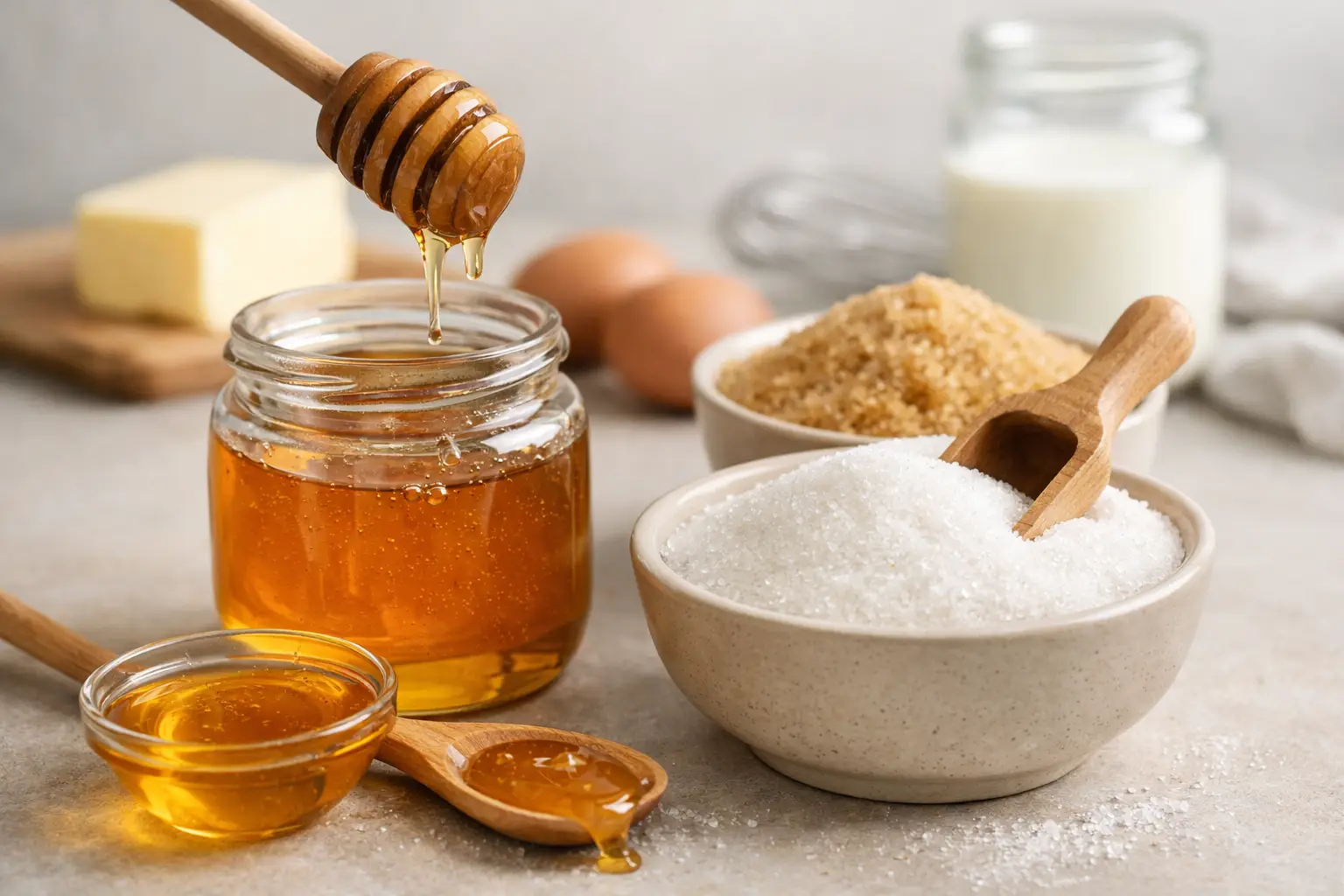
A reliable honey sugar conversion can turn an ordinary recipe into something warmer, more fragrant, and more satisfying. But honey is not simply sugar in liquid form. Pure Sidr honey brings its own sweetness, moisture, color, and distinctive depth, so successful substitutions call for a few thoughtful adjustments rather than a straight one-to-one swap.
For families choosing more natural pantry staples, that extra care is worthwhile. A spoonful of authentic Yemeni Sidr honey carries a rich, caramel-like sweetness shaped by Yemen’s ancient Sidr trees and traditional harvesting practices. Used well, it can add character to morning tea, homemade dressings, baked goods, and everyday cooking.
Honey Sugar Conversion: The Basic Ratio
When replacing granulated white sugar with honey, begin with 2/3 cup honey for every 1 cup sugar. Honey generally tastes sweeter than table sugar, so this ratio preserves sweetness without overwhelming the recipe.
For smaller amounts, use these practical conversions:
| Granulated sugar | Honey to use | | — | — | | 1 tablespoon sugar | 2 teaspoons honey | | 1/4 cup sugar | 3 tablespoons honey | | 1/2 cup sugar | 1/3 cup honey | | 3/4 cup sugar | 1/2 cup honey | | 1 cup sugar | 2/3 cup honey |
These are strong starting points, not rigid rules. A delicate vanilla cake may taste best with slightly less honey, while a spiced loaf, oatmeal cookie, or barbecue glaze can welcome its fuller flavor. Sidr honey is especially beautiful in recipes where its naturally complex taste has room to be noticed.
Why Honey Requires Recipe Adjustments
Granulated sugar is dry and neutral. Honey contains natural sugars along with water, organic acids, and aromatic compounds. That moisture is welcome in many recipes, but it changes the balance of ingredients.
If you use honey in place of sugar for baking, reduce another liquid in the recipe by about 1/4 cup for each cup of honey used. For example, a recipe calling for 1 cup sugar may become 2/3 cup honey. Since that is less than a full cup of honey, reduce milk, water, juice, or another liquid by roughly 2 to 3 tablespoons.
Honey also browns more quickly than white sugar. Lower the oven temperature by about 25 degrees Fahrenheit and begin checking for doneness a little early. This is particularly useful for cookies, cakes, muffins, and quick breads, where a deeply browned surface can arrive before the center has fully baked.
A small amount of baking soda can help balance honey’s natural acidity in recipes that need lift. A common guideline is 1/4 teaspoon baking soda per cup of honey. Still, use judgment. If a recipe already contains baking soda, buttermilk, yogurt, cocoa, or other acidic ingredients, adding more can affect flavor and texture. Start conservatively, especially with a favorite family recipe.
Honey Sugar Conversion by Weight
Measuring by weight is the most accurate way to make a honey sugar conversion, especially when baking. One cup of granulated sugar weighs approximately 200 grams. One cup of honey weighs about 340 grams because it is much denser.
That means the standard swap of 2/3 cup honey for 1 cup sugar is roughly 225 to 230 grams of honey for 200 grams of sugar. A kitchen scale makes this simple and repeatable, whether you are adapting a single batch of muffins or preparing a larger recipe for a gathering.
Honey can cling to measuring cups and spoons, which makes volume measurements less precise. Lightly coating the measuring tool with a neutral oil can help the honey slide out cleanly. Better yet, place the mixing bowl on a scale, zero it, and pour slowly until you reach the desired weight. Every drop of Nature’s Gold stays where it belongs: in the recipe.
Where Honey Works Best Instead of Sugar
Honey is an easy replacement in drinks, sauces, marinades, oatmeal, yogurt, and salad dressings. In these uses, there is usually no need to reduce liquid or change cooking temperatures. Stir in a little at a time, then taste. Cold drinks may need extra stirring because honey dissolves more slowly when chilled.
In baking, honey performs especially well in moist, warmly flavored recipes. Think banana bread, carrot cake, date bars, granola, ginger cookies, cornbread, and spiced muffins. Its moisture helps keep baked goods tender for longer, while its deeper flavor supports cinnamon, cardamom, ginger, nuts, and dried fruit.
It can be less predictable in recipes designed around sugar’s dry, crystalline structure. Meringues, crisp shortbread, airy angel food cake, and certain candy recipes depend on granulated sugar for volume, texture, or temperature control. Honey may still have a role, but replacing all of the sugar can change the result dramatically.
For cookies, consider a partial substitution before going all in. Replace half the sugar with honey, reduce the liquid modestly, and expect a softer, chewier cookie with more spread. If crisp edges are the goal, keeping some granulated sugar is often the better choice.
A Note on Sweetness and Nutrition
Honey and table sugar are both sources of sugars, and both should fit thoughtfully within an overall balanced eating pattern. Honey is not a free pass to use unlimited sweetness. Its appeal lies in more than a nutrition label: it offers concentrated flavor, so many people find they can use less while enjoying more character in a dish.
Pure, unprocessed honey also contains naturally occurring compounds and small amounts of nutrients that refined white sugar does not provide. The exact composition varies with floral source, season, and handling. That variation is part of what makes genuine honey so special, but it also means broad claims about identical health effects or blood sugar responses are not dependable for every person.
If you manage diabetes, follow a medically directed eating plan, or are monitoring carbohydrate intake closely, account for honey as a sugar-containing food and speak with your healthcare professional about what suits your needs. Honey should never be given to children under 12 months old.
Choosing the Right Honey for the Recipe
The honey you choose matters. Mass-market blends can be mild and generic, while single-origin honey brings a clearer sense of place. Authentic Yemeni Sidr honey is prized for its full-bodied aroma, smooth texture, and deep, lingering finish. A small amount can transform a simple bowl of Greek yogurt, a cup of tea, or a glaze for roasted vegetables.
Because premium honey has a flavor worth preserving, avoid using it only where it will disappear among heavily processed ingredients. Let it shine in simple preparations: warm water with lemon, tahini dressing, overnight oats, fresh fruit, or a finishing drizzle over toast and soft cheese. At Yemen Honey Store, this respect for origin is at the heart of offering genuine Sidr honey straight from Yemen’s treasured landscapes.
Store honey tightly sealed at room temperature, away from direct sunlight and excess heat. Natural crystallization can happen over time and does not mean the honey has spoiled. To gently return it to a smoother consistency, place the closed jar in warm water. Avoid high heat or microwaving when possible, since gentle handling best protects honey’s natural aroma and quality.
Make the First Swap Simple
Start with a recipe you already know well. Replace the sugar in oatmeal, tea, a vinaigrette, or a simple loaf cake, and notice what changes: the sweetness, the color, the moisture, and the finish on the palate. Once you understand how your chosen honey behaves, honey sugar conversion becomes less like a formula and more like a trusted kitchen instinct.
The finest results come from tasting as you go and giving a remarkable ingredient the space to speak for itself.