
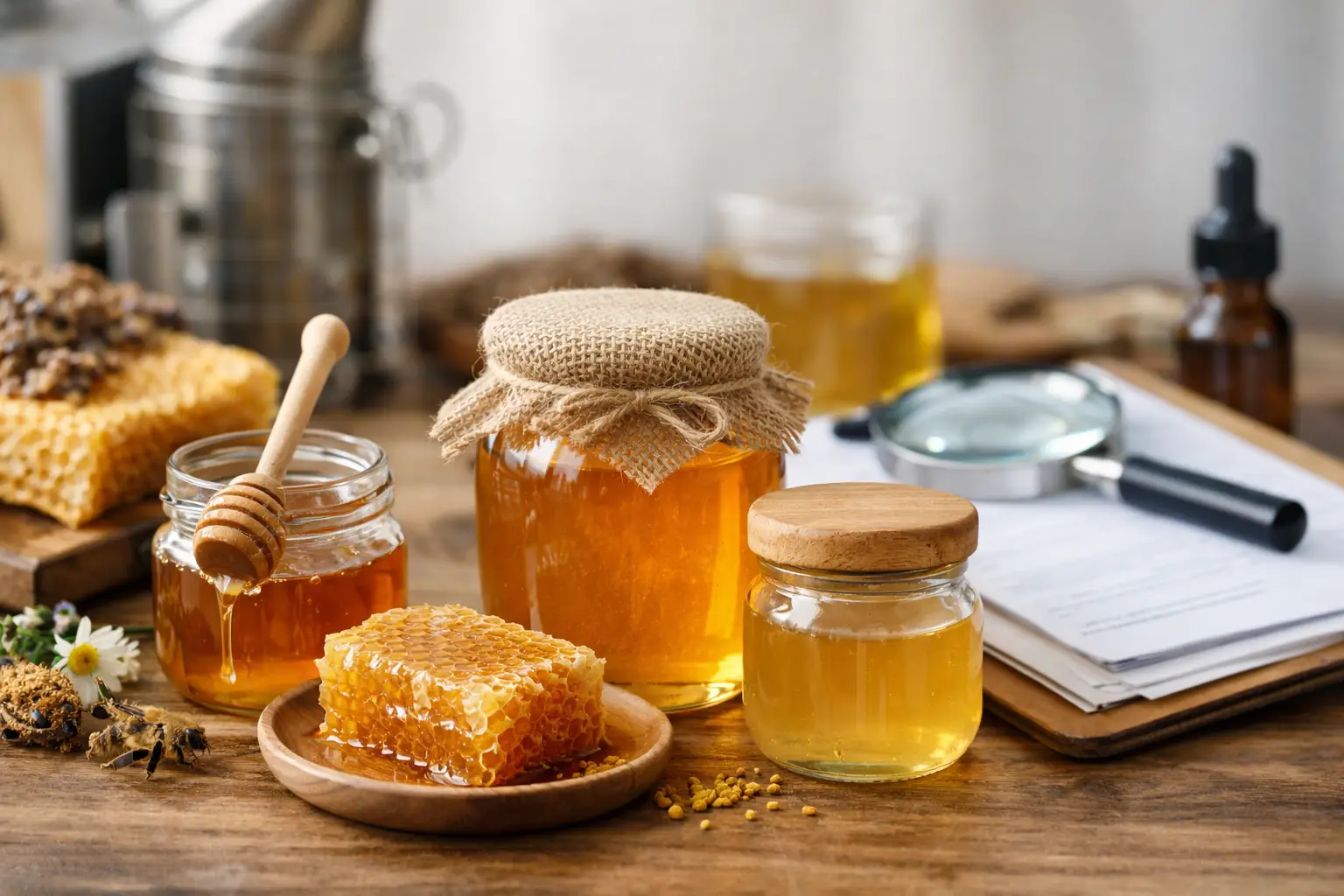
A beautiful honey label can tell a powerful story: wildflowers, mountain valleys, ancient trees, traditional beekeeping. Yet the most meaningful proof is often found in the small print. This guide to honey certifications helps you read beyond the front-label promises and choose honey with the purity, traceability, and character your table deserves.
For premium honey lovers, certifications and verification are not just paperwork. They are part of the trust between the beekeeper, the land, and the jar in your pantry. They can help distinguish carefully sourced honey from products that are blended, overheated, filtered beyond recognition, or vague about where they began.
Why Honey Certifications Matter
Honey is one of nature’s simplest foods, but the modern honey market is not always simple. A jar may carry words such as “pure,” “raw,” “natural,” or “premium,” and those terms do not all carry the same legal meaning or level of outside oversight.
A credible certification or third-party test gives shoppers a clearer basis for comparison. It may verify how bees and hives are managed, whether the product meets organic standards, whether certain residues were tested, or whether a processor follows documented food-safety practices. Just as valuable, a detailed origin statement can connect honey to a specific country, region, floral source, or harvest tradition.
Still, no single seal can tell the entire story. Honey is agricultural, seasonal, and deeply tied to its landscape. The strongest sign of quality is usually a combination of transparent sourcing, appropriate testing, careful handling, and a seller willing to explain what is in the jar and where it came from.
USDA Organic: What the Seal Can and Cannot Tell You
For American shoppers, USDA Organic is among the most familiar certifications. When honey is certified organic, the producer and supply chain have met defined standards and undergone oversight through an approved certifier. In general, organic honey standards address the management of hives and the handling and processing of honey, with restrictions around prohibited substances.
The seal can be reassuring, particularly for people who prioritize organic food across their kitchen. It indicates more than a marketing claim because it involves recordkeeping and certification requirements.
But honey presents a special challenge. Bees travel freely, often covering miles in search of nectar. No beekeeper can control every flower a bee visits. That is why responsible organic honey producers and certifiers must consider the surrounding forage area, hive location, bee health practices, and the handling of honey after harvest.
Organic certification is meaningful, but it is not the only marker of exceptional honey. A rare, traditionally harvested Yemeni Sidr honey may be produced in remote landscapes with minimal intervention yet not carry a USDA Organic seal because of the cost, logistics, or availability of certification in its region. In that case, origin transparency and trustworthy sourcing become especially important.
Look for the certifier, not only the word “organic”
A legitimate organic claim should identify a recognized certifying body or clearly state the certification status. If a label simply uses phrases like “organic style” or “made with natural organic goodness,” treat the language carefully. It may describe an aspiration rather than an audited standard.
Raw Honey Is a Handling Claim, Not a Universal Certification
“Raw” has become a favorite word among honey shoppers, and for good reason. Many people seek honey that has been minimally processed and gently handled to preserve its natural aroma, color, and distinctive character.
However, raw honey is generally not a single government certification with one universal definition. Different producers may use the word differently. Some mean the honey was never heated. Others mean it was warmed only enough to make bottling practical. Some raw honey is lightly strained to remove natural hive particles, while other jars retain more visible pollen and wax.
Rather than relying on the word alone, ask how the honey was handled. Was it heated? If so, why and to what extent? Was it ultrafiltered, or simply strained? A transparent producer should be comfortable describing its process in plain language.
Crystallization can also be a reassuring sign, not a flaw. Real honey naturally crystallizes over time, and the rate depends on floral source, temperature, and natural sugar composition. A smooth liquid jar is not automatically inferior, but honey that never changes at all may deserve a closer look at its processing and ingredients.
Purity Testing: One of the Most Useful Forms of Verification
Purity is central to the value of premium honey. Consumers should receive honey, not a diluted blend of inexpensive syrups or undisclosed sweeteners. This is where laboratory testing can be particularly valuable.
Advanced testing may screen for added sugar syrups, examine honey’s natural chemical profile, or look for residues such as antibiotics, pesticides, and heavy metals. The exact method matters, as does the laboratory’s competence and the scope of the test. A generic statement that honey is “lab tested” is a starting point, not a complete answer.
When evaluating a purity claim, consider what was tested and whether the results relate to the actual batch being sold. Testing cannot replace honest sourcing, but it adds another layer of confidence. For a treasured varietal honey, it also helps protect the flavor, value, and heritage that make it special.
Be cautious with absolute promises that sound too broad to verify. “100% pure” is a desirable standard, yet the strongest brands support that promise with clear ingredient information, documented sourcing, and quality controls rather than relying on bold words alone.
Country of Origin and Floral Source Claims
Country of origin is not always a formal certification, but it is one of the most important pieces of information on a honey label. Honey labeled as a blend of multiple countries may still be safe and enjoyable, but it offers a different experience from a single-origin honey with a known harvest area.
Single-origin honey gives you a closer connection to place. Yemen’s Sidr honey, for example, is valued for its relationship to the Sidr tree, the region’s ancient beekeeping heritage, and a rich, distinctive taste that cannot be reduced to a generic honey blend. A credible seller should be able to name Yemen as the source and explain the honey’s regional or floral identity without making vague claims of exotic rarity.
“Monofloral” is another useful term, meaning the honey comes primarily from the nectar of one flower or tree. It does not mean bees visited only one plant, which would be nearly impossible. Instead, it reflects a dominant nectar source supported by location, harvest timing, sensory qualities, and, in some cases, pollen analysis.
For Sidr honey, the goal is not a flashy label. It is a traceable connection to the Sidr blossoms and the Yemeni landscape that gives the honey its treasured profile.
Food Safety Certifications and What They Cover
You may also see food-safety certifications associated with the facility that packs or processes honey. These can show that a business follows structured procedures for sanitation, traceability, hazard control, and recordkeeping. They matter because even exceptional raw material deserves careful handling on its way to your home.
Food-safety certification does not certify that honey is raw, organic, or from a particular flower. It addresses a different question: whether the operation has systems designed to manage safety and consistency. Think of it as one piece of a larger quality picture.
A dependable honey company should also provide a clear ingredient statement. For pure honey, the ingredient list should be beautifully short: honey. Added flavors, sweeteners, or fillers belong on the label and should never be hidden behind a wellness-focused presentation.
A Practical Guide to Honey Certifications Before You Buy
Before choosing a jar, pause for a few moments and read the label with intention. Start with the country of origin, then look for a specific region or floral source when the honey is sold as a specialty variety. Check whether organic and food-safety claims name a certifier, and look for straightforward information about ingredients and processing.
If purity testing is mentioned, seek detail rather than slogans. If the honey is called raw, look for an explanation of its handling. And if a brand makes unusually broad health promises, remember that honey is a natural food, not a substitute for medical care. Its value can be enjoyed as part of a balanced lifestyle, in warm drinks, family recipes, daily rituals, and thoughtful gifts.
At Yemen Honey Store, we believe Nature’s Gold should carry the dignity of its origin. Genuine Yemeni Sidr honey does not need exaggerated claims when its taste, tradition, and careful sourcing speak clearly for themselves.
The best jar is not always the one with the most seals on the label. Choose the one whose story can be verified, whose ingredients are honest, and whose origin brings you closer to the land and beekeeping heritage behind every spoonful.