
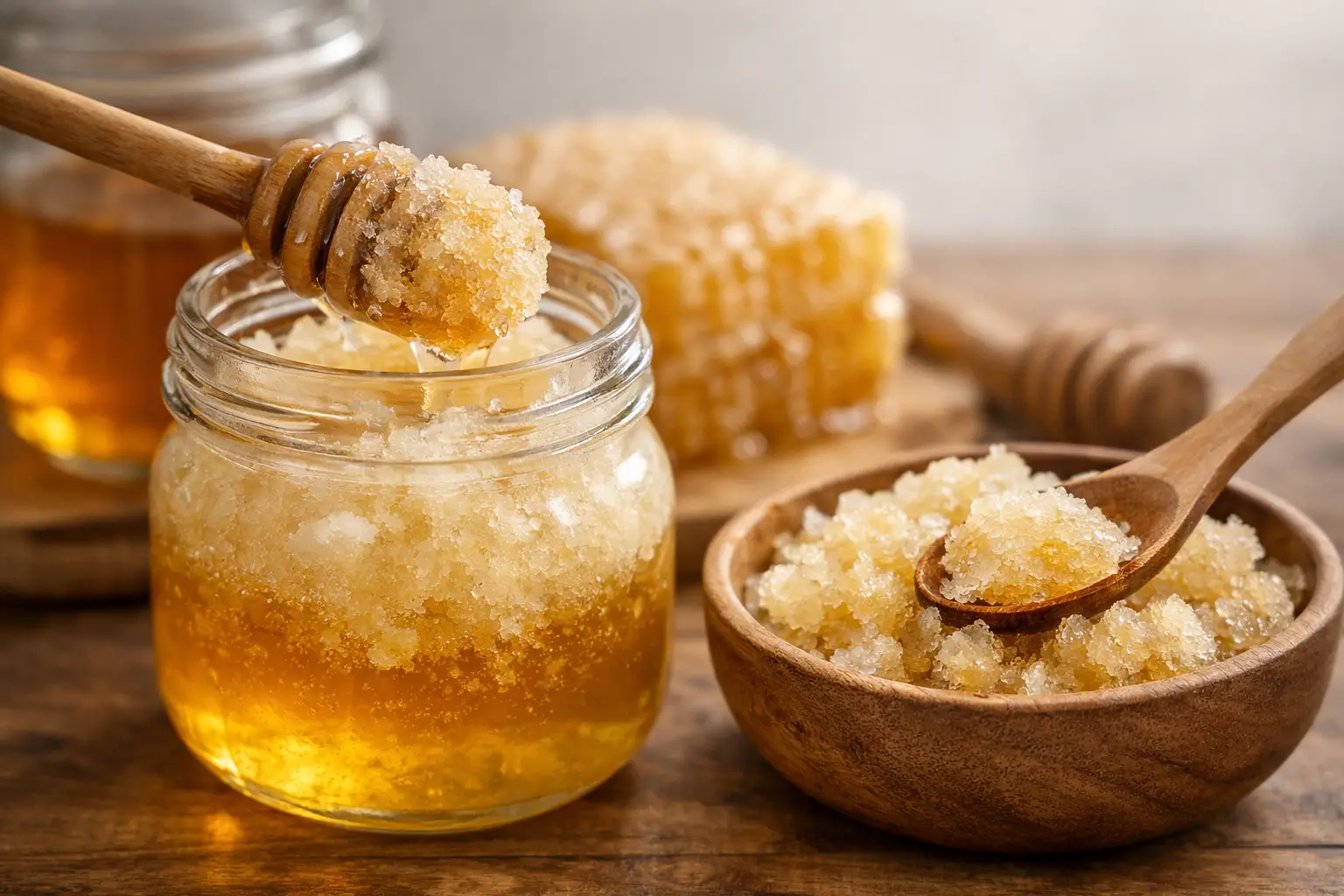
You open a jar of raw honey expecting a smooth golden pour, and instead you find a thick, grainy texture or a jar that has turned almost solid. For many first-time buyers, that moment raises an immediate question: has the honey gone bad? Raw honey crystallization explained in the simplest way is this – crystallization is a natural sign that your honey is real, unprocessed, and still carrying the character nature gave it.
For premium honey lovers, especially those choosing rare varieties like authentic Yemeni Sidr, this matters. A changing texture can feel surprising when you have invested in a jar prized for purity and origin. But crystallization is not spoilage. In many cases, it is exactly what natural honey is supposed to do.
What crystallization in raw honey actually means
Honey is a concentrated natural sugar solution. It contains more sugar than water can comfortably hold over time, which means it is naturally unstable in the best sense of the word. Eventually, some of the glucose separates from the water and forms tiny crystals. Those crystals spread, and the honey becomes cloudy, creamy, grainy, or firm.
This process happens because raw honey is alive with natural variation. Its floral source, mineral profile, pollen content, storage temperature, and moisture level all influence how quickly it changes. When honey is heavily processed and filtered, some of those natural elements are reduced. Raw honey keeps them. That is why crystallization is often more common in raw, unfiltered honey than in commercial squeeze-bottle honey designed to stay liquid for long periods.
In other words, the jar is not failing. It is behaving naturally.
Raw honey crystallization explained by sugar balance
To understand why one jar stays fluid while another turns dense, it helps to look at the two main sugars in honey: fructose and glucose. Honey with a higher glucose content tends to crystallize faster. Honey with more fructose tends to remain liquid longer.
This is one reason all raw honey does not behave the same way. Some floral varieties crystallize quickly and develop a fine, spreadable texture. Others stay smooth for months, sometimes longer. Even within the same variety, seasonal differences can affect the pace.
Sidr honey is often prized for its rich taste, smooth body, and naturally luxurious texture. Depending on harvest conditions and storage, it may crystallize more slowly than some common supermarket honeys. But slower does not mean never. Real honey still changes. That is part of its authenticity.
Why temperature makes such a difference
Storage temperature is one of the biggest factors behind crystallization. Raw honey tends to crystallize fastest around 50 to 59 degrees Fahrenheit. That means a cool pantry, basement, or winter shipping environment can encourage crystals to form sooner.
By contrast, very warm temperatures can delay crystallization, but there is a trade-off. Excessive heat can damage the very qualities people seek in raw honey, including its natural enzymes, aroma, and delicate flavor notes. If you value purity, warming should always be gentle.
Refrigeration is usually the quickest way to make crystallization happen. Many people assume the fridge preserves honey best, but honey is naturally shelf-stable when stored properly. For raw honey, the refrigerator often creates a texture problem without adding meaningful benefit.
Does crystallized honey mean it is pure?
Crystallization is a good sign, but it is not the only sign. Pure raw honey often crystallizes because it still contains its natural sugars, pollen, and micronutrients in their original balance. That said, timing varies so much that crystallization alone should not be treated as a laboratory test.
A liquid jar is not automatically impure, and a crystallized jar is not automatically superior. Floral origin matters. Moisture matters. Storage matters. Processing matters too.
What crystallization does tell you is that the honey has not been engineered to behave like a uniform industrial syrup. Natural honey has character. It may thicken in one season and loosen in another. That texture shift is often part of the honest story of a minimally handled product.
What raw honey crystallization looks like
Not every jar crystallizes in the same pattern. Sometimes the honey becomes evenly creamy from top to bottom. Sometimes a firm layer forms at the bottom while liquid remains on top. In other jars, tiny crystals make the honey look cloudy before it turns thick.
Color can shift slightly as well. A crystallized jar may look lighter or more opaque than it did when fully liquid. That visual change can be dramatic in a clear container, but it is usually normal.
Texture is where most people notice it first. Crystallized honey may become spreadable like soft butter, grainy like fine sugar, or dense enough to scoop with a spoon. None of those textures mean the honey is unsafe to eat.
How to return crystallized honey to a liquid state
If you prefer your honey fluid, patience and gentle heat are the best tools. Place the jar in warm water, not boiling water, and let it rest. Stirring occasionally can help the crystals dissolve more evenly.
The key is moderation. High heat may liquefy honey quickly, but it can also strip away some of the natural qualities that make raw honey special in the first place. Microwaving is convenient, yet it often creates hot spots that overheat part of the jar while leaving other parts crystallized. For premium raw honey, that is not the best approach.
A warm water bath preserves more of the honey’s original integrity. Change the water as it cools, and give the process time. Good honey deserves a gentle hand.
How to slow crystallization without overprocessing
If you want your honey to stay liquid longer, store it at a stable room temperature in a tightly sealed jar. Keep it away from cold spaces and avoid introducing moisture with a wet spoon.
That said, slowing crystallization and preventing it entirely are not the same thing. With truly raw honey, there is always a chance the texture will change over time. This is especially true if the jar experiences temperature swings during shipping or seasonal weather changes.
For many honey lovers, the better mindset is not to fight crystallization at all costs, but to understand it. Some actually prefer crystallized honey for toast, drizzling onto warm bread, or stirring into oatmeal. A spoonable, creamy texture can be part of the pleasure.
Is crystallized honey still good for wellness routines?
Yes, as long as it has been stored properly and remains clean, crystallized raw honey is still good to use. Its texture may change, but that does not mean its natural value disappears. Whether you enjoy honey by the spoon, in warm water, over breakfast, or as part of a family wellness routine, crystallization does not make it less authentic.
The one caution is heat. If your goal is to preserve the natural character of raw honey, avoid aggressive warming. Gentle handling respects the integrity of the product.
For shoppers seeking traditional, origin-specific honey, that distinction matters. A honey valued for heritage and purity should not be treated like a generic sweetener. It should be stored thoughtfully and enjoyed in the form nature allows.
Raw honey crystallization explained for premium buyers
When you choose a rare honey with a strong sense of place, you are not buying factory consistency. You are buying floral origin, landscape, season, and tradition in a jar. That means slight differences in taste, color, and texture are part of the experience.
This is especially true with exceptional honey sourced from traditional regions where purity still matters. A jar that slowly thickens or crystallizes is often showing you that it has not been diluted, over-filtered, or stripped of its natural identity. For customers who value honey straight from the heart of Yemen, that is reassuring rather than disappointing.
At Yemen Honey Store, that purity is central to the promise. Nature’s Gold should look and behave like a natural product, not a laboratory-made syrup.
The next time your raw honey turns cloudy, dense, or spoon-thick, take it as a reminder that real honey has seasons of its own. A jar that crystallizes is not losing its worth. It is quietly proving where it came from and how little it has been changed.