
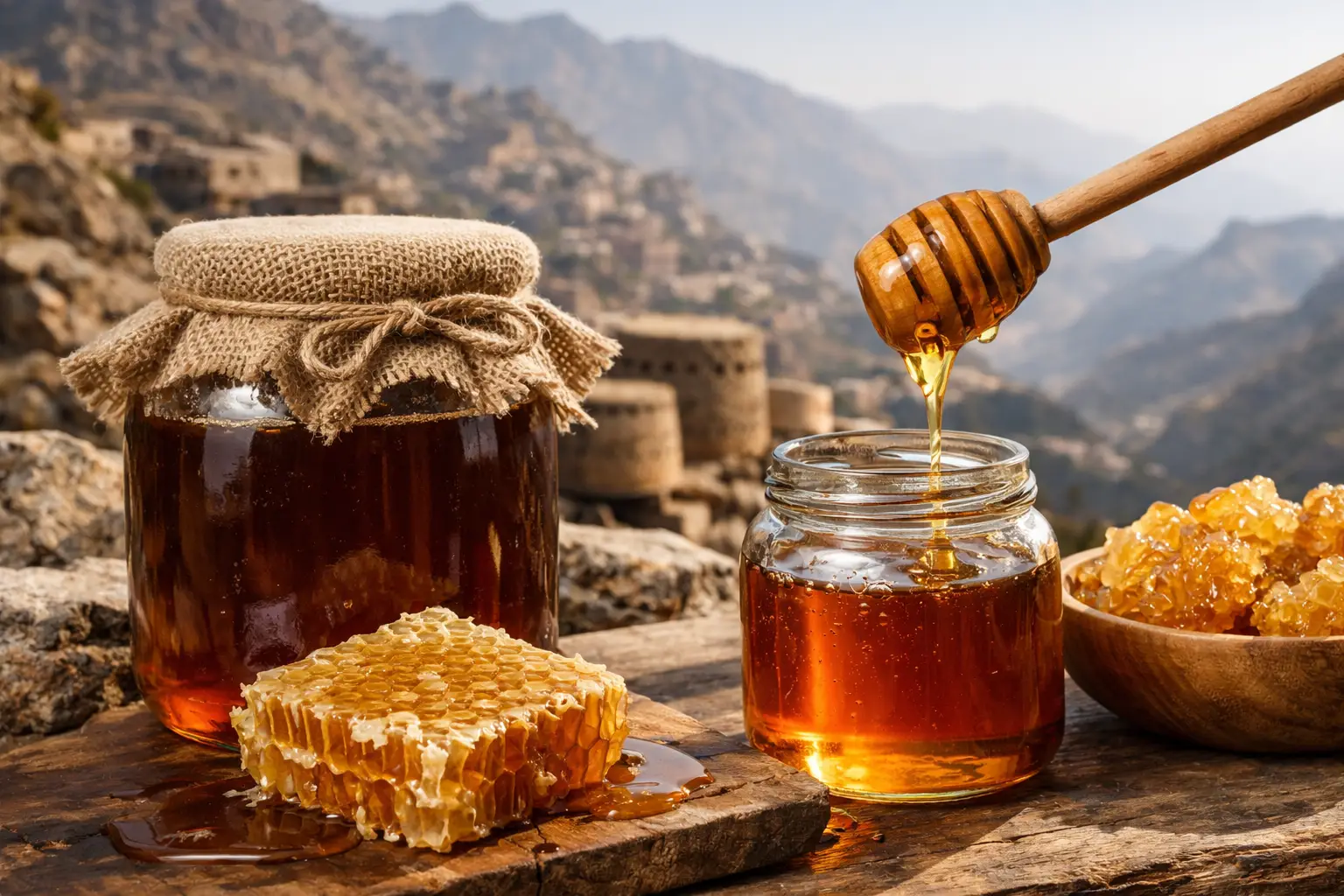
The first time many shoppers see the price of genuine Sidr honey from Yemen, the reaction is immediate: why is Yemeni honey expensive compared with other jars on the shelf? The short answer is that it is not priced like ordinary honey because it is not ordinary honey. Its value comes from rarity, origin, labor, purity, and a harvesting tradition that has been protected for generations.
For buyers in the US who care about natural foods, clean sourcing, and authentic wellness products, the price starts to make sense once you understand what is behind each jar. This is Nature’s Gold Straight from the Heart of Yemen, and nearly every part of its journey is more demanding than mass-market honey.
Why is Yemeni honey expensive compared with regular honey?
Most supermarket honey is produced at scale. It may come from blended sources, large commercial apiaries, and high-volume processing systems designed to keep costs low. That model is built for efficiency.
Yemeni honey, especially Sidr honey, is built on a completely different foundation. It comes from a specific region, a specific floral source, and a much more limited production cycle. Beekeepers are not chasing volume. They are protecting quality, purity, and the character of the honey itself.
That difference matters. When a product is tied to a rare environment and careful harvesting rather than industrial scale, the price naturally rises.
The Sidr tree itself is a major reason
Not all Yemeni honey is the same, but Sidr honey is the variety most often associated with premium pricing. It comes from bees that forage on the nectar of ancient Sidr trees, which are highly prized across the region.
These trees do not exist in endless commercial plantations. They grow in distinct landscapes and depend on local climate, seasonal timing, and natural conditions that cannot simply be replicated anywhere. That means Sidr honey begins with scarcity.
There is also a taste and texture factor. Pure Sidr honey is known for a rich, layered flavor and a dense, smooth consistency that many buyers seek out specifically. People are not just buying sweetness. They are buying a distinctive sensory experience tied to a precise botanical origin.
Harvesting is traditional, slow, and labor-intensive
One of the biggest answers to why is Yemeni honey expensive is the way it is harvested. This is not an assembly-line product. In many cases, beekeeping in Yemen still relies on traditional methods that require close knowledge of terrain, flowering seasons, hive behavior, and careful extraction.
That level of craftsmanship takes time. Hives must be managed with attention rather than pushed for maximum output. Honey is collected more selectively, and the process is shaped by preserving quality instead of speeding up production.
There is a trade-off here. Industrial honey can be cheaper because volume comes first. Traditional Yemeni honey costs more because the beekeeper’s priority is authenticity and purity. For buyers who value unprocessed foods, that difference is part of the appeal.
Pure honey costs more than blended honey
A low price often tells you something about how a honey was handled. In many parts of the global market, honey may be filtered heavily, blended from multiple origins, heated aggressively, or diluted in ways that reduce quality and erase traceability.
Authentic Yemeni honey is valued precisely because it is expected to be 100% natural, unprocessed, and additive-free. That kind of integrity is harder to produce and harder to protect.
Purity also creates accountability. When a brand offers origin-specific honey rather than a generic blend, it is making a stronger promise. That promise adds value, but it also raises the cost of sourcing, verification, and careful handling.
Geography makes sourcing harder
Yemen’s landscapes are part of what give its honey such a strong reputation. Remote valleys, mountain regions, and untouched natural areas create the conditions for exceptional nectar sources. But those same conditions make collection and transport more difficult.
Moving honey from remote beekeeping areas to buyers abroad is not simple. There are logistical obstacles, limited supply chains, and extra layers of care needed to preserve product quality. In practical terms, a premium jar of Yemeni honey has traveled a far more complex path than a commodity honey produced close to major commercial hubs.
This is where many consumers begin to see the real story behind the price. They are paying not just for the honey itself, but for the difficulty of bringing an authentic product from its place of origin to their table without compromising it.
Reputation affects value too
Some foods earn premium status because the market has seen consistent quality over time. Yemeni honey has that kind of reputation. For many buyers across the Middle East and beyond, it is considered one of the most treasured honeys in the world.
That reputation did not appear by accident. It comes from generations of harvesting, from trust in origin, and from a product that has long been appreciated for both flavor and traditional wellness use. When demand grows around a product with limited supply, the price rises.
This does not mean every expensive jar is automatically worth it. It means genuine Yemeni honey commands a premium because informed buyers understand what they are looking at.
Why is Yemeni honey expensive for US buyers in particular?
For customers in the United States, the price can feel even higher because imported specialty foods carry additional costs beyond production. There is shipping, storage, import handling, smaller batch distribution, and the reality that authentic Yemeni honey is not a mainstream grocery item.
You are also paying for access. A product that is rare in the US market and difficult to source responsibly will never be priced like a domestic bulk sweetener. If the honey is truly origin-specific and carefully brought in for a niche audience, premium pricing is part of that equation.
There is another factor as well: trust. US buyers looking for genuine imported honey often want reassurance that what they are buying is real. Brands that focus on authenticity, careful sourcing, and purity standards are doing work behind the scenes that cheap sellers often avoid.
Wellness positioning adds demand, but quality still matters most
Many people buy Sidr honey for more than taste. They use it as part of a daily wellness routine, for natural energy, for family use, or as a more meaningful alternative to processed sweeteners. That demand can increase price, especially when buyers see the product as both a premium food and a natural health staple.
Still, wellness interest alone is not enough to justify a high price. The product has to deliver on quality. If the honey is genuinely raw, pure, and sourced from the right floral origin, then the higher price reflects something real. If those things are unclear, the premium may not be justified.
That is why origin transparency matters so much in this category.
Expensive does not always mean overpriced
There is a difference between a high price and an inflated one. A jar of authentic Yemeni honey can be expensive because every step behind it is costly and limited. That is very different from a product that is simply marketed with luxury language.
The best way to judge value is to ask what you are actually getting. Are you buying true Yemeni Sidr honey with a clear origin story, natural production methods, and minimal processing? Or are you paying a premium for packaging and vague claims?
For many shoppers, the answer comes down to priorities. If you want a sweetener for tea, cheaper honey may be perfectly fine. If you want a rare, culturally rooted, additive-free honey with a distinctive flavor and a trusted reputation, the premium becomes easier to understand.
What you are really paying for
When people ask why is Yemeni honey expensive, the deeper answer is that they are paying for rarity that cannot be mass-produced, for traditional labor that cannot be rushed, and for purity that cannot be faked without losing the product’s true character.
They are also paying for a piece of heritage. Authentic Yemeni honey carries the story of ancient Sidr trees, skilled beekeepers, and landscapes that still shape the flavor of the final jar. That kind of food is increasingly rare in a market full of generic blends and processed shortcuts.
At Yemen Honey Store, that is the standard that matters most: genuine honey with a clear sense of place, protected in its natural form and offered to US customers who care about quality they can trust.
If the price gives you pause, that is reasonable. Premium honey should make you ask questions. But once you understand the origin, the harvest, and the purity behind it, the better question may be whether a truly authentic jar was ever likely to be cheap in the first place.