
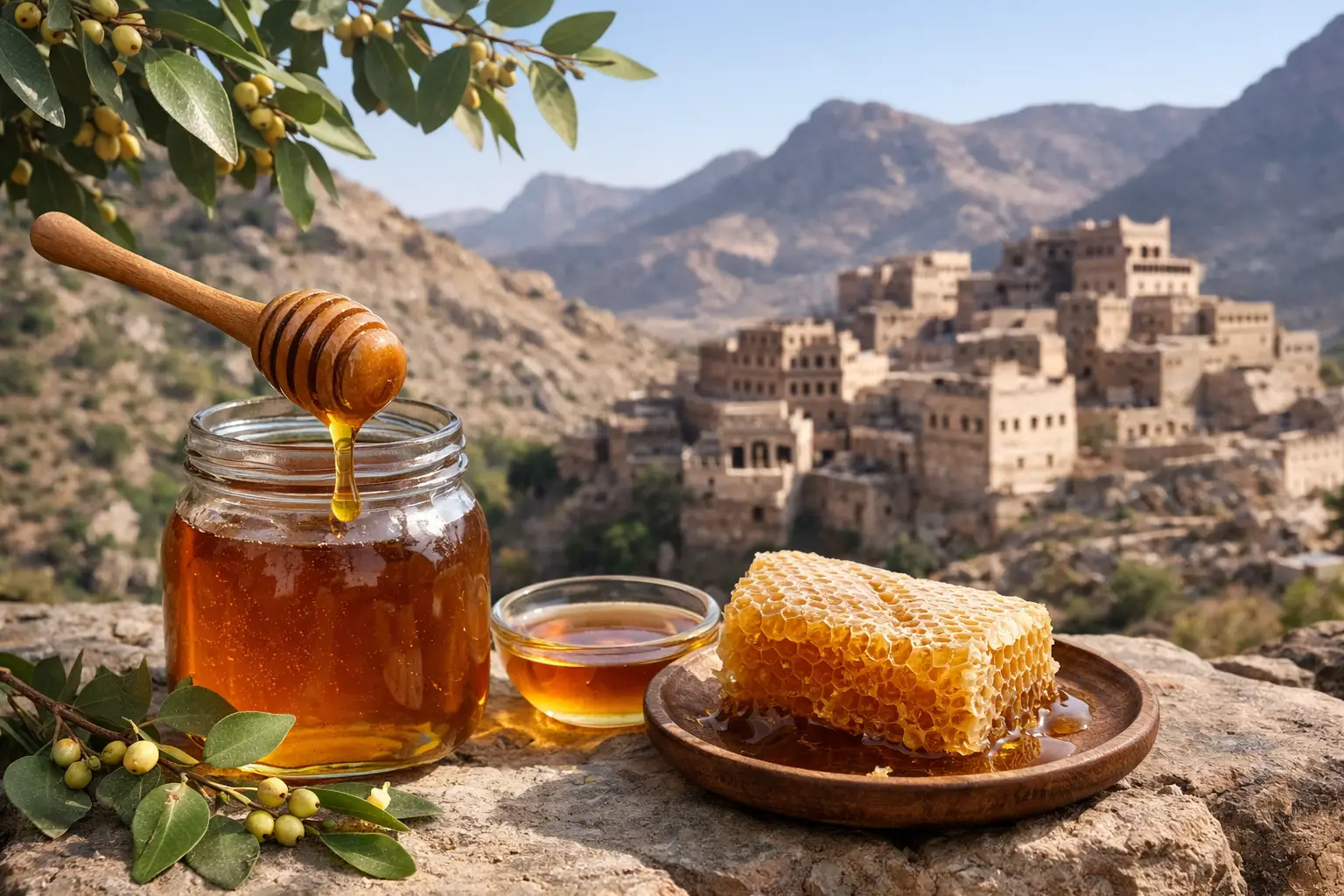
A jar of true Sidr honey carries more than sweetness. The sidr tree honey origin is written into its deep amber color, naturally rich aroma, and complex, lingering taste. It begins in Yemen, where ancient Sidr trees grow across rugged valleys and mountain landscapes that have supported beekeepers and their families for generations.
For those seeking honey with a clear story, Yemen’s Sidr honey stands apart. It is not a generic label or a mass-produced blend. At its best, it is Nature’s Gold – harvested from a specific tree, shaped by a distinctive landscape, and handled with the care that a rare food deserves.
What Is the Sidr Tree?
The Sidr tree is known botanically as Ziziphus spina-christi. It is a hardy, drought-tolerant tree with small flowers that attract bees when they bloom. It grows in parts of the Middle East, North Africa, and South Asia, but the tree has an especially deep cultural and agricultural connection to Yemen.
In Yemen, Sidr trees are often found growing naturally rather than in large, uniform commercial plantations. Their roots are adapted to dry terrain, and their presence has long been part of the rhythm of rural life. The tree is valued for its shade, fruit, wood, and place in local tradition. For beekeepers, however, its blossoms are the beginning of one of the region’s most treasured harvests.
Sidr honey is made when bees collect nectar primarily from these flowers. That floral source matters. Nectar influences a honey’s aroma, color, flavor, and natural composition. While all honey begins with bees and blossoms, not all floral sources create the same finished honey. Sidr nectar is known for producing a honey that is full-bodied, smooth, and richly layered rather than simply sugary.
The Sidr Tree Honey Origin in Yemen
Yemen is widely recognized as the spiritual home of the world’s most sought-after Sidr honey. The country’s geography is central to that reputation. Dry air, dramatic elevations, scattered vegetation, and remote valleys create conditions very different from those of industrial agricultural regions.
Areas such as Hadramout, including the renowned Wadi Do’an valley, are closely associated with exceptional Yemeni Sidr honey. In these landscapes, bees forage among Sidr blossoms during a limited flowering season. The harvest is therefore tied to nature’s calendar, not a factory schedule.
This is one reason authentic Sidr honey is rare. A beekeeper cannot simply produce more of it on demand. Flowering periods are seasonal, weather can affect nectar flow, and the amount of honey available depends on the health of the colonies and the surrounding environment. A smaller harvest is not a flaw. Often, it is part of what makes genuine Yemeni Sidr honey so valuable.
Yemen is not the only place where Sidr trees grow, and honey sold as Sidr may come from several countries. That does not automatically make one jar good and another poor. But origin changes the story. Yemeni Sidr honey reflects Yemeni land, local bee forage, and a beekeeping heritage that has earned respect far beyond the region.
Why Yemen’s Landscape Makes a Difference
Honey is a reflection of place. Wine lovers use the word terroir to describe how soil, climate, and terrain shape a bottle. The same idea applies beautifully to honey. The location of the hive, the blossoms available to bees, rainfall patterns, elevation, and seasonal temperatures all leave their mark on the final harvest.
Yemen’s untouched landscapes offer a setting that many premium honey buyers appreciate: a closer connection between the hive and the natural environment. Sidr trees grow amid valleys and hills where intensive farming is limited in many areas. This can reduce exposure to the large-scale monoculture that often defines commodity honey production.
That does not mean every honey described as “wild” or “natural” is automatically authentic. Those words alone are not proof. The meaningful question is whether the seller can clearly identify where the honey was harvested, what the bees foraged on, and how the honey was handled afterward.
Authentic origin is especially important because demand for Sidr honey has grown. A label may mention Sidr without telling you whether the honey is primarily Sidr nectar, blended with other honey, heavily filtered, or sourced from the region it claims. Transparency is what turns a beautiful origin story into a purchase you can trust.
From Traditional Hives to the Jar
For generations, Yemeni beekeepers have followed methods built around observation, patience, and respect for the bees. Hives are placed where Sidr blossoms are available, and harvesting is timed around the bloom. The work is demanding. Beekeepers must protect colonies, monitor weather, travel through difficult terrain, and collect honey without compromising its natural character.
After harvest, careful handling helps preserve what makes Sidr honey special. Premium honey should contain one simple ingredient: honey. No corn syrup, artificial flavoring, added sugar, or unnecessary fillers belong in the jar.
Many people also look for honey that is unprocessed or minimally processed. In practical terms, this means it has not been subjected to excessive heat or aggressive filtering that can alter its natural aroma, color, and texture. Gentle straining may remove wax particles or hive debris, while still allowing the honey to remain close to its original form.
Texture can vary from one harvest to the next. Color may range from golden amber to a deep reddish brown. Flavor can be buttery, caramel-like, herbal, or slightly fruity, with a gentle tang at the finish. These natural differences are signs of a living food shaped by season and source, not a standardized sweetener engineered to taste identical every time.
How to Recognize Genuine Yemeni Sidr Honey
A premium jar should offer more than an attractive name. Start with the origin. Look for a clear statement that the honey comes from Yemen, ideally with information about the region or valley. A seller who is proud of the source should be prepared to speak plainly about it.
Next, check the ingredients. Pure Sidr honey should list honey and nothing else. The flavor should be naturally rich, not perfumed or artificially sweet. True Sidr honey is often dense and smooth, but consistency alone cannot prove authenticity because temperature and moisture naturally affect honey.
Price can also provide context. Genuine Yemeni Sidr honey requires seasonal blooms, skilled labor, careful transport, and limited supply. It is a premium food, so an unusually low price deserves a closer look. At the same time, a high price by itself is not a guarantee. Clear sourcing and a commitment to purity matter more than marketing language.
Crystallization is another point that can confuse buyers. Pure honey may crystallize over time, especially when stored in cooler conditions. This is a natural change in texture, not a sign that honey has gone bad. If desired, place the sealed jar in warm water for a short time to gently soften it. Avoid high heat, which can diminish the flavor that makes Sidr honey so enjoyable.
A Heritage Food for Everyday Rituals
Sidr honey has long been cherished as both a special food and a traditional wellness staple. It contains naturally occurring sugars for quick energy and has small amounts of plant compounds, minerals, and antioxidants that come from its floral source. Still, it is honey, and it should be enjoyed thoughtfully as part of a balanced diet.
A spoonful can bring depth to warm tea, plain yogurt, oatmeal, tahini, or a cheese board. Its bold flavor also makes it worthy of a simpler ritual: served by the spoonful, slowly, when you want to taste the harvest rather than cover it with other ingredients. It makes a meaningful gift for families, hosts, and anyone who values foods with a genuine sense of place.
Never give honey of any kind to children under 12 months old. Adults managing blood sugar or dietary restrictions should also consider honey’s natural sugar content and seek personalized guidance when needed.
At Yemen Honey Store, authentic Yemeni Sidr honey is chosen for people who want purity they can taste and a heritage they can feel. When you choose honey that is Straight from the Heart of Yemen, you are bringing a small part of an ancient landscape to your table. Let each spoonful be a reminder to choose foods whose origins are as honest and remarkable as their flavor.