
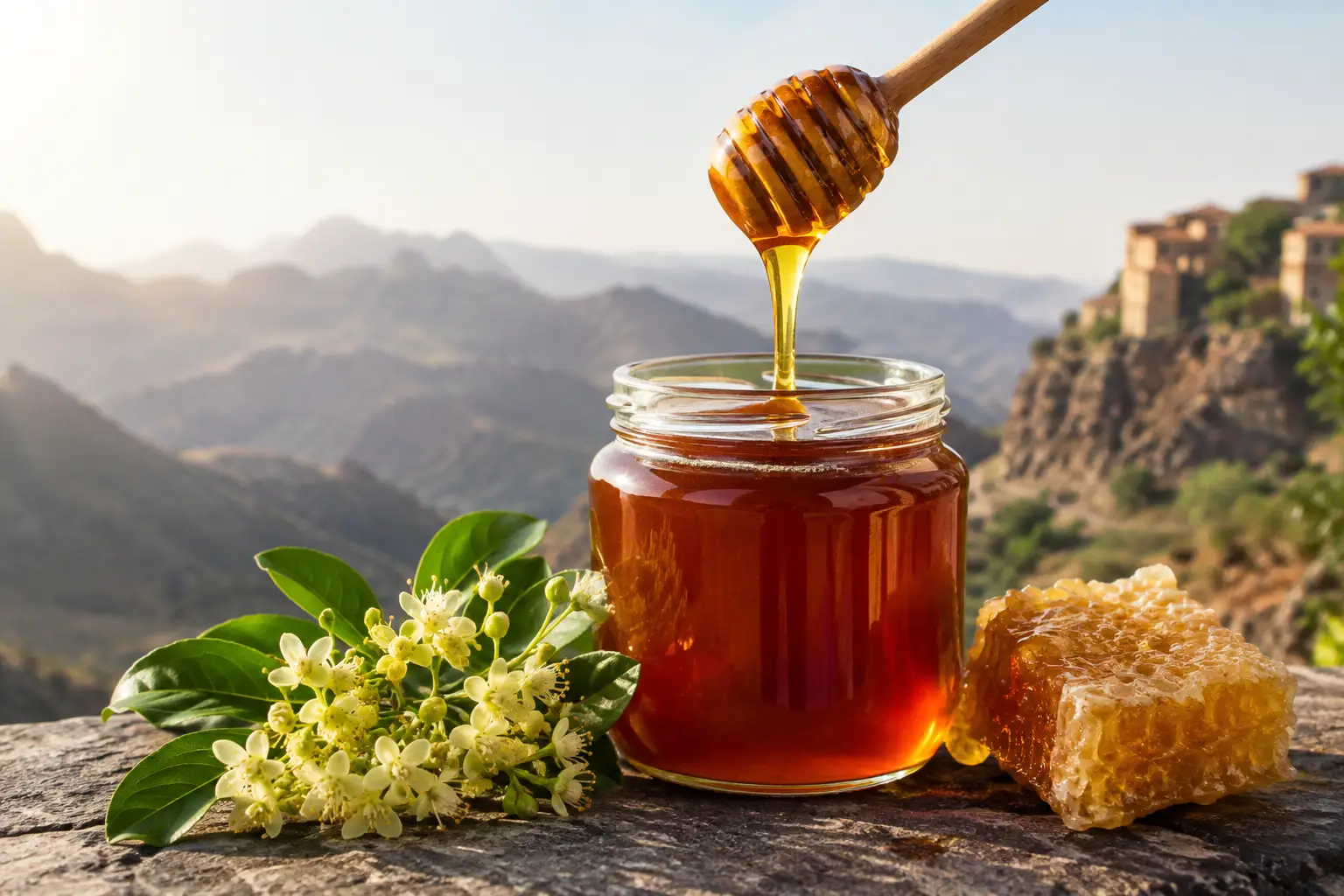
A spoonful of Sidr honey does more than sweeten tea. Its deep amber color, velvety texture, and warm, caramel-like finish carry the character of Yemen’s rugged valleys and ancient Sidr trees. For families seeking foods with a clear origin and a story worth knowing, this is honey with a true sense of place.
Unlike anonymous supermarket blends, authentic Yemeni Sidr honey is valued for where it comes from, how it is harvested, and what is left out of it. It is Nature’s Gold in the most literal sense: a pure food made by bees, gathered with care, and treasured across generations.
What Is Sidr Honey?
Sidr honey is produced when bees forage primarily from the blossoms of the Sidr tree, also known as the lote tree. These resilient trees grow in parts of Yemen’s dry, mountainous landscape, where their roots run deep and their seasonal blooms provide a distinctive nectar source.
The result is a honey unlike the light, mild varieties many Americans know. Genuine Sidr honey is usually golden to dark amber, depending on the harvest and region. Its flavor is rich yet balanced, often with notes of caramel, dried fruit, warm spice, and a gentle earthiness. It is sweet, of course, but not one-dimensional.
The name matters because honey’s flavor and character begin with the flowers visited by bees. When the nectar comes from Sidr blossoms in Yemen, the honey reflects that rare botanical and geographic origin. That is why source transparency is not a luxury detail. It is the foundation of authenticity.
Why Yemeni Sidr Honey Is So Highly Prized
Yemen has a long beekeeping heritage shaped by its climate, terrain, and traditional knowledge. In regions where Sidr trees grow naturally, beekeepers have harvested honey in ways that respect the season, the hives, and the limited flowering period.
Sidr blooms are not available year-round, and harvests can vary from one season to the next. This limited supply is part of what gives authentic Yemeni Sidr honey its premium reputation. It should never be treated like a mass-produced commodity that is identical in every jar.
Its rarity also explains why careful sourcing matters. Honey labeled as Sidr may differ greatly in purity, floral origin, and country of harvest. Some products are blended with less expensive honey. Others may use the Sidr name without offering a meaningful connection to Yemeni land or traditional production. A honey’s label can make a claim, but its origin story should be able to support it.
At Yemen Honey Store, the focus is simple: bringing authentic, natural Yemeni Sidr honey to American homes without diluting the heritage that makes it special.
A Taste That Belongs at the Table
The first reason people return to Sidr honey is often taste. Its fuller body makes a small spoonful feel satisfying, whether it is enjoyed on its own or paired with everyday foods.
Try it over Greek yogurt, warm oatmeal, fresh fruit, toast with tahini, or a soft cheese board. Stir it into tea after the water has cooled slightly, or use it to finish roasted carrots, baked pears, and simple vinaigrettes. Because its flavor is so distinct, it works best when it can be noticed rather than buried under heavy ingredients.
There is a trade-off here. Sidr honey is not the least expensive sweetener in the pantry, so it may not be the jar you reach for when a recipe needs two cups of honey. It shines in moments where quality matters more than volume: a morning ritual, a thoughtful gift, or the final touch on a meal.
Sidr Honey and Everyday Wellness
Honey has long held a place in traditional food cultures, not only for sweetness but also for comfort, nourishment, and natural energy. Sidr honey fits naturally into that tradition. It contains naturally occurring sugars that can provide a quick source of energy, along with small amounts of compounds found in honey such as antioxidants, enzymes, amino acids, and trace minerals.
The exact nutritional profile varies with the season, nectar source, storage, and handling. That is true of all real honey. It is best to view Sidr honey as a nutrient-rich whole food, not as a replacement for medical care or a guaranteed remedy for a health condition.
Many people enjoy a spoonful as part of a balanced morning routine, before activity, or when they want a more meaningful alternative to refined sugar. Its smooth texture can also make it a comforting addition to warm drinks during dry-weather months. What matters most is consistency in the basics: a varied diet, adequate rest, hydration, and foods that are minimally processed.
For parents, one safety rule is essential: honey should not be given to children under 12 months old. For everyone else, moderation is wise. Even pure, unprocessed honey is a concentrated source of natural sugar.
How to Recognize Authentic Sidr Honey
A premium honey should invite questions. In fact, the more valuable the honey, the more worthwhile it is to ask where it came from and how it reached your table.
Look first for a clearly stated country of origin. “Yemeni Sidr honey” should mean more than a marketing phrase. The seller should be able to explain that the honey is sourced from Yemen and connected to Sidr blossoms, rather than presenting a vague blend with an impressive label.
Next, pay attention to ingredients. Pure honey needs only one ingredient: honey. There should be no corn syrup, artificial flavoring, added sweeteners, or unnecessary fillers. Unprocessed and additive-free honey preserves the straightforward integrity that discerning buyers expect.
Color alone is not a perfect test of quality. Sidr honey may be lighter or darker depending on the harvest. Crystallization is not automatically a sign that honey has gone bad either. Real honey can crystallize naturally over time, especially in cooler conditions. If you prefer a more fluid texture, place the sealed jar in warm water and let it loosen gently. Avoid overheating it, since high heat can alter honey’s natural character.
Finally, consider the producer’s values. Honest sourcing, careful handling, and a respect for Yemeni heritage are meaningful signs that the honey was chosen for more than its name.
Storing Your Sidr Honey Well
Sidr honey is wonderfully low-maintenance. Keep the jar tightly sealed in a cool, dry cupboard away from direct sunlight. There is no need to refrigerate it, and refrigeration can encourage crystallization.
Always use a clean, dry spoon. Introducing water or food particles into the jar can affect its texture and freshness over time. With proper storage, honey remains enjoyable for a long time, though its color and texture may gradually evolve as a natural product.
Treat each jar as a seasonal expression rather than something manufactured to be perfectly uniform. A change in shade, aroma, or crystallization pattern is often part of honey’s honest, unprocessed nature.
A Gift With Meaning Beyond the Jar
Sidr honey makes a memorable gift because it feels personal without needing an occasion. It is a beautiful choice for hosts, food lovers, wellness-minded friends, and family members who appreciate heritage-rich ingredients.
More than that, it offers a connection to a place many people may never visit but can still experience through taste. Each spoonful reflects the work of bees, beekeepers, Sidr blossoms, and the enduring landscapes of Yemen. That connection is precisely what makes authentic honey worth seeking out.
The best way to enjoy Sidr honey is often the simplest: take a quiet spoonful, notice its depth, and let a small daily ritual bring the Heart of Yemen a little closer to home.