
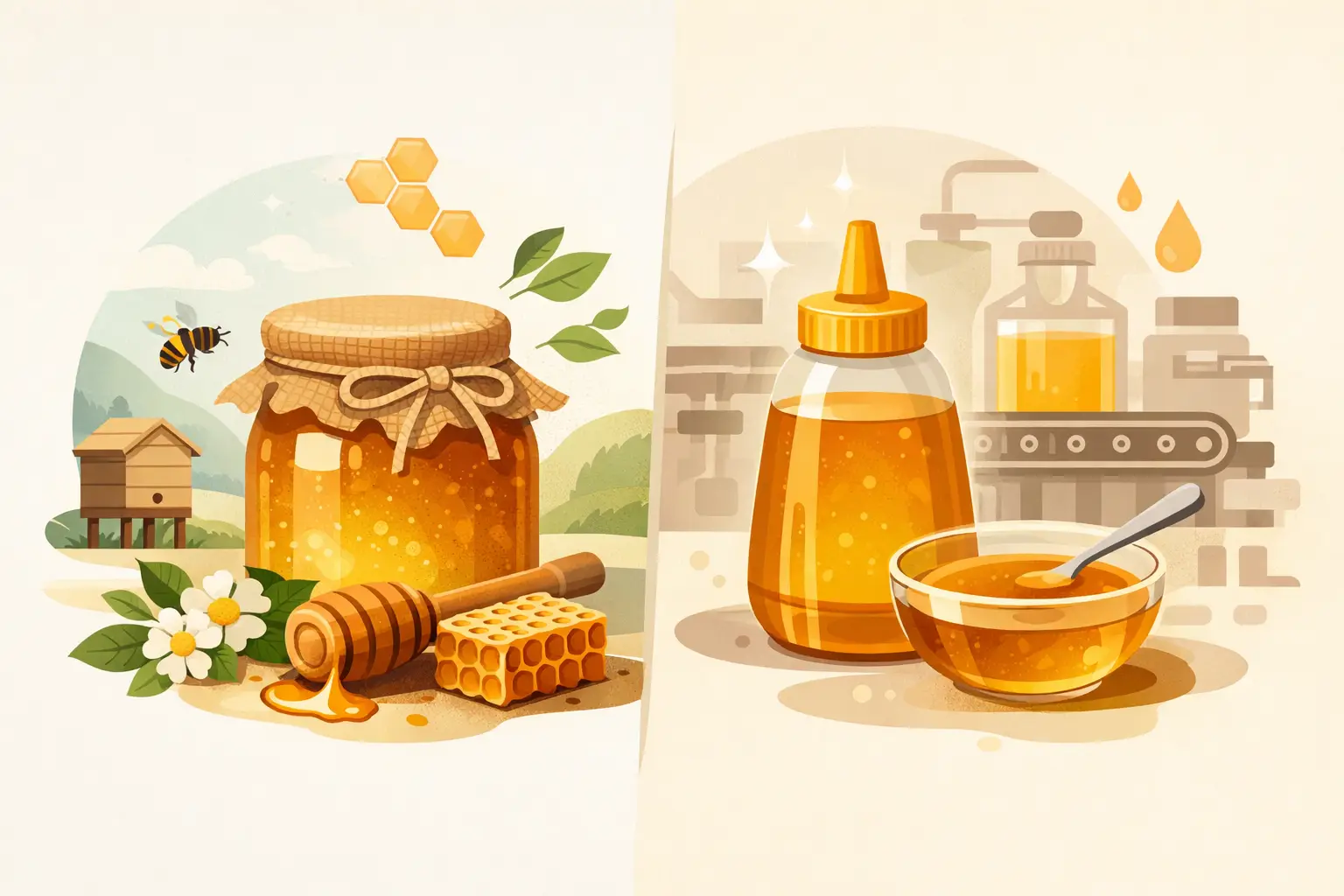
You can taste the difference before you read the label. One spoonful is layered, floral, and alive with character. The other is simply sweet. That is the real starting point in the raw honey vs processed honey conversation – not a trend, but a question of what happened to the honey before it reached your kitchen.
For shoppers who care about purity, origin, and natural wellness, this distinction matters. Honey is not just a sweetener when it is handled with care. It carries the imprint of the flowers, the land, the season, and the traditional methods behind it. Once heavy processing enters the picture, much of that identity can be reduced or removed.
Raw Honey vs Processed Honey: What Is the Difference?
Raw honey is honey in a form that stays close to how it exists in the hive. It is typically extracted, lightly strained to remove natural debris such as bits of wax, and then jarred without high heat or intensive industrial filtration. The goal is simple – preserve the honey’s natural profile.
Processed honey usually goes through more intervention. It may be heated to make bottling easier, filtered to create a clearer and more uniform look, and blended for consistency across batches. In large commercial production, these steps are often designed for shelf presentation and mass distribution rather than for preserving the honey’s original complexity.
That does not mean every processed honey product is poor quality, and it does not mean every jar labeled raw is exceptional. The difference is in how much of the honey’s natural state remains intact and how transparent the producer is about sourcing and handling.
Why Processing Changes Honey
Honey is sensitive to temperature and handling. When manufacturers heat it significantly, the texture becomes smoother and the flow becomes easier. That helps on an industrial filling line, and it delays crystallization, which many mainstream shoppers mistakenly view as a flaw.
But crystallization is not a flaw at all. It is one of the most natural things real honey does. In fact, many pure and unprocessed honeys crystallize over time because of their natural glucose content. A jar that stays perfectly liquid forever may look convenient, but convenience and authenticity are not always the same thing.
Filtration changes honey too. Light straining is normal and practical. Heavy filtration is different. It removes more of the natural material that gives honey its distinct appearance and character. The result is often a cleaner-looking product, but also a less expressive one.
Heat and nutrition
People often ask whether raw honey is more nutritious. In general, raw honey is valued because minimal processing helps preserve naturally occurring enzymes, trace compounds, and delicate plant-derived elements that may be affected by higher heat.
This is where nuance matters. Honey is still primarily a natural sugar source whether it is raw or processed. It should not be treated like a miracle food. At the same time, not all honey is nutritionally equal. A carefully sourced raw honey can offer more than sweetness alone, especially when compared with heavily processed, blended supermarket honey.
Filtration and identity
Honey from a specific region has a story in its flavor. Floral source, climate, soil, and tradition all shape the final jar. Over-filtering and blending can flatten those differences. What you gain in visual uniformity, you often lose in origin character.
For those who seek specialty honey, that character is the point. A premium honey should taste like where it came from.
Taste, Texture, and Color in Raw Honey vs Processed Honey
If you line up raw and processed honey side by side, the differences are often visible. Raw honey may appear cloudier, thicker, or less uniform in color. It may develop crystals. It may even vary from one harvest to the next. Those are usually signs of a natural product rather than warning signs.
Processed honey is often clearer, thinner, and more standardized. Many consumers have been taught to equate that polished appearance with quality, but with honey, visual perfection can be misleading.
Taste is where the contrast becomes obvious. Raw honey tends to have depth. You may notice herbal notes, floral brightness, earthy richness, or a lingering finish that feels distinct to its botanical source. Processed honey often tastes more one-dimensional because the handling and blending are designed for consistency, not personality.
That is especially important with heritage honeys. Sidr honey, for example, is prized not just for being sweet, but for its remarkable flavor, dense texture, and naturally rich profile. Honey like that deserves minimal interference.
The Sourcing Question Matters as Much as Processing
A useful raw honey vs processed honey comparison cannot stop at heat and filtration. Source matters just as much.
Some honey products on the market are blends from multiple countries, packed in a way that makes origin hard to trace. Others may be ultra-filtered or mixed to create a standard taste profile. Even when the front label sounds wholesome, the backstory may be vague.
That is why serious honey buyers look beyond marketing words. They want to know where the honey came from, how it was harvested, and whether the producer values purity over volume. A truly premium honey should offer confidence in all three.
For many American shoppers, this is part of the appeal of origin-specific honey from a place with deep beekeeping traditions. When honey comes from a known region with cultural heritage behind it, the product feels more trustworthy and more meaningful. It is not just honey. It is Nature’s Gold, shaped by landscape and tradition.
Is Raw Honey Always Better?
Usually, for people who prioritize purity and original flavor, raw honey is the better choice. But there are a few practical considerations.
Raw honey can crystallize faster. Its appearance may change with temperature. It may cost more because it is produced on a smaller scale and handled with more care. For some shoppers, that is a worthwhile trade. For others who only want a low-cost sweetener for baking in large quantities, processed honey may feel more convenient.
There is also the issue of trust. The word raw has strong appeal, but labels alone are not enough. A credible product should be supported by clear sourcing, honest handling practices, and a brand that treats honey as a natural food rather than a factory-standard syrup.
So yes, raw honey is often the more desirable option, but only when it is genuinely raw, genuinely pure, and genuinely traceable.
How to Choose the Right Honey for Your Home
Start with your reason for buying it. If you want honey for tea, toast, wellness routines, gifting, or daily use as a premium pantry staple, raw honey usually offers more value in flavor and integrity. If you care about natural foods and try to avoid overprocessed products, it aligns better with that lifestyle.
Next, look at origin. Single-origin honey tells you more than a generic blend ever can. It reflects a place, and that place influences the taste and quality. Honey Straight from the Heart of Yemen, harvested with respect for tradition and purity, carries a very different story from a mass-market squeeze bottle designed for uniformity.
Then consider texture and seasonality. Natural variation is normal. A jar may be thick one month and more crystallized later on. That does not mean anything is wrong. It often means the honey has been left closer to its natural state.
Finally, think in terms of standards rather than slogans. The best honey is not the one with the loudest packaging. It is the one with the clearest origin, the fewest interventions, and the strongest commitment to authenticity.
Raw Honey vs Processed Honey for Wellness-Minded Buyers
For families and health-conscious adults, honey often sits at the intersection of food and tradition. It is stirred into warm water, paired with herbs, used before a workout for natural energy, or enjoyed by the spoonful as part of a daily routine. In those moments, quality matters.
If you are choosing honey as a natural luxury and not just a sugar substitute, processed honey can feel like a compromise. You may still get sweetness, but you miss the fuller sensory experience and some of the value that comes from minimal handling.
That is why specialty brands such as Yemen Honey Store focus so strongly on unprocessed, additive-free honey with a clear heritage story. For this kind of buyer, purity is not a marketing extra. It is the foundation of trust.
The best jar of honey should give you more than sweetness. It should offer a sense of place, confidence in what you are eating, and the pleasure of something real. When you choose honey with that standard in mind, the difference becomes beautifully clear.