
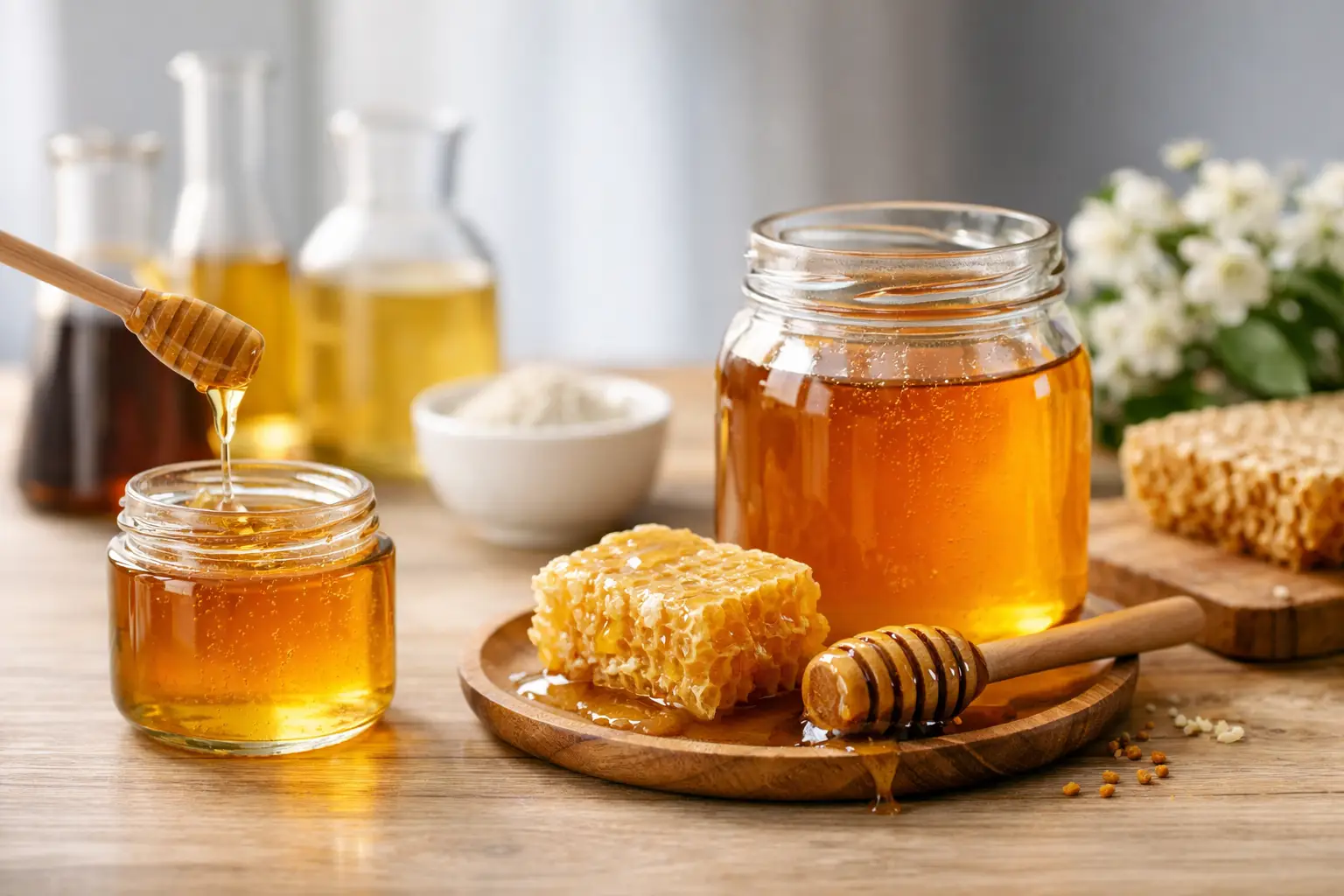
A jar of honey should have a remarkably simple answer to the question, does honey contain additives? Pure honey does not need them. It is made by bees from flower nectar, then collected, strained when needed, and bottled. Its deep color, floral aroma, and naturally changing texture are part of the honey itself – not ingredients that need to be manufactured or enhanced.
For shoppers looking for a truly natural food, the distinction matters. Honey is often chosen for morning tea, family recipes, traditional wellness routines, and a more meaningful alternative to heavily processed sweeteners. Yet a golden jar alone cannot tell you everything about what is inside. Understanding labels, source, and the difference between processing and adulteration can help you choose honey with confidence.
Does Honey Contain Additives in Its Pure Form?
No. Pure honey contains no added sweeteners, flavors, colors, preservatives, or thickeners. The only ingredient should be honey.
Honey is naturally complex without being complicated. Its character comes from the nectar source, the weather, the soil, the region, and the work of the bees. It naturally contains sugars such as fructose and glucose, along with small amounts of water, enzymes, organic acids, pollen, and plant-derived compounds. These are naturally present components, not additives.
This is why a single-origin honey can taste so distinctive. Yemeni Sidr honey, gathered where bees forage around the revered Sidr tree, is known for a rich, layered taste and a warm amber-to-dark-golden appearance. Its qualities come straight from the landscape and traditional harvesting heritage of Yemen. Nothing artificial is required to make it memorable.
The word “additive” generally means something introduced after the honey is produced. In a pure jar, there should be no need for vanilla flavoring to improve aroma, caramel coloring to deepen the shade, or preservatives to make the honey shelf-stable. Honey’s naturally low moisture and acidic environment already help it keep well when stored properly.
Additives, Processing, and Adulteration Are Not the Same
These terms are often used interchangeably, but they describe different concerns.
An additive is an ingredient intentionally added to food. In honey, that could include added flavorings, syrups, colors, or other substances. A honey product with additions may still be safe to eat, but it is not the same as a jar of pure honey. It should be clearly described and labeled for what it is.
Processing refers to what happens to honey after harvest. Filtering may remove wax particles and other visible material. Gentle warming can make honey easier to pour or bottle. These steps do not automatically mean additives were used. However, heavy filtration and high heat can change the honey’s natural profile, including some of the delicate aroma and naturally occurring components that many people value in minimally handled honey.
Adulteration is the most serious issue. It means honey has been diluted or mixed with cheaper sweeteners, such as sugar syrups, while being presented as pure honey. That is not a matter of personal taste or a different processing preference. It compromises the product’s authenticity.
For discerning buyers, purity involves more than avoiding a list of unfamiliar ingredients. It means knowing that the honey is truly honey and that its origin story matches what is in the jar.
Why “Raw” Is Not a Complete Purity Guarantee
Raw honey can be an appealing choice because it is often minimally heated and filtered. Still, “raw” is not a universal promise that answers every quality question by itself. Practices and terminology can vary between producers.
A better approach is to consider the full picture: the ingredient statement, the country and floral source, the producer’s transparency, and whether the honey is sold as a single-origin product. A brand that can clearly explain where its honey comes from and how it is handled gives you more to work with than a vague label alone.
How to Read a Honey Label With Confidence
The clearest label is also the simplest. Turn the jar around and look for an ingredient list that says “honey.” That is the standard worth seeking when your goal is additive-free honey.
Be careful with products described as honey sauce, honey spread, honey syrup, or flavored honey. These may be delicious in the right context, but they can include other ingredients. Read the full label rather than assuming that the word “honey” on the front means the product contains nothing else.
Country-of-origin information is another meaningful clue. Honey is often blended across regions, which can make the flavor consistent but may make its journey harder to trace. Single-origin honey offers a clearer connection between the jar and the place that shaped it. For a heritage honey such as Sidr, origin is central to its value, not a decorative detail.
Look for a producer that speaks plainly about sourcing. Broad phrases such as “pure” or “natural” are reassuring only when they are supported by real information. Can the seller identify the region? Do they name the floral source? Do they explain whether the honey is blended, flavored, or processed? Transparency is part of quality.
Finally, do not judge purity by color or thickness alone. Light honey can be pure, and dark honey can be pure. Some varieties remain fluid for a long time; others crystallize quickly. These differences reflect natural sugar balance, temperature, and nectar source more than they prove anything about additives.
Natural Changes That Do Not Mean Something Was Added
Pure honey does not behave like a factory-made syrup, and that is often a good sign. Its appearance and texture can shift over time without changing its essential nature.
Crystallization is the best-known example. When honey develops fine or coarse crystals, it has not gone bad and does not need to be discarded. Crystallization happens naturally as glucose separates from the liquid portion of the honey. Some honeys crystallize within weeks, while others can stay smooth for much longer.
If you prefer a pourable texture, place the tightly closed jar in warm water and let it soften gradually. Avoid aggressive heating, especially in a microwave, which can create hot spots and dull the honey’s delicate flavor.
Seasonal variation is natural, too. Even honey from the same region may look or taste slightly different from one harvest to the next. Rainfall, flowering conditions, and the bees’ forage all leave their signature. For people who value real food, that variation is not a flaw. It is evidence that nature, rather than an artificial formula, remains in charge.
Why Origin Matters for Sidr Honey
Sidr honey is treasured because the Sidr tree and its growing environment give the honey a distinct identity. In Yemen, this tradition carries cultural depth as well as culinary value. The harvest is connected to landscapes and beekeeping knowledge passed through generations.
That heritage deserves care at every step. When honey is presented as Yemeni Sidr, the expectation is not merely a sweet taste. It is a promise of a specific botanical source, a particular place, and a product handled with respect for its natural qualities.
At Yemen Honey Store, authentic Yemeni Sidr honey is offered as Nature’s Gold – valued for its pure ingredient profile, exceptional taste, and direct connection to the heart of Yemen. For customers in the United States, that kind of provenance can turn an everyday spoonful into something far more special.
A Few Smart Storage Habits
Keep honey tightly sealed in a cool, dry cupboard away from direct sunlight. There is no need to refrigerate it, and refrigeration may encourage crystallization sooner. Always use a clean, dry spoon to avoid introducing moisture or food particles into the jar.
If the honey’s aroma, flavor, or appearance seems unusual, consider storage conditions first. A reliable seller and proper handling are the foundation, but honey is still a natural food and deserves the same simple care you would give any premium pantry ingredient.
When you choose a jar with one honest ingredient, clear origin, and a flavor shaped by its source, you are choosing more than sweetness. You are bringing home a small, golden expression of place, tradition, and the patient work of bees.