
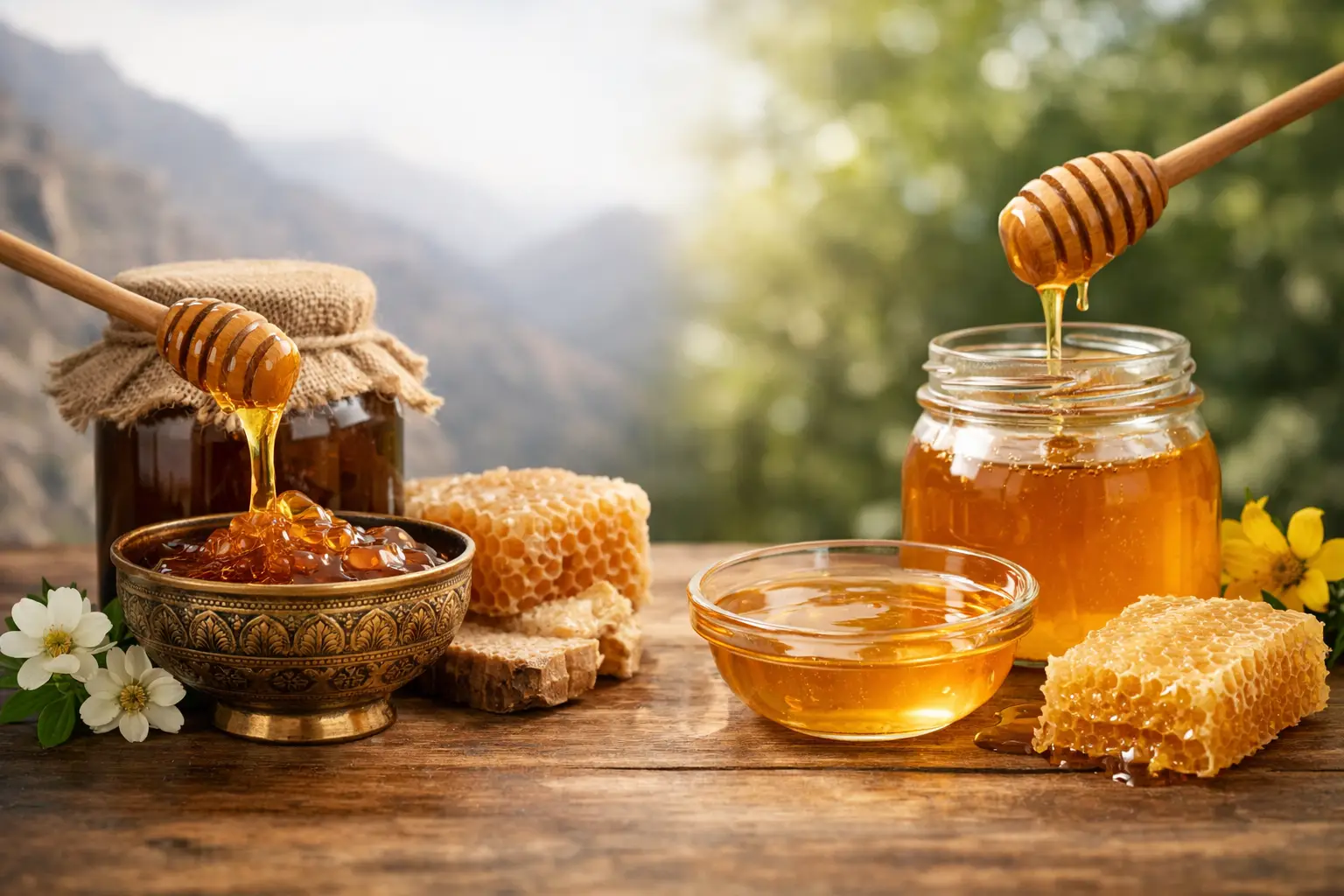
A spoonful can tell a story. In the conversation around Yemeni honey vs regular honey, the real difference is not simply that one costs more or comes from farther away. It is about the tree, the landscape, the harvest, and the care taken to preserve what the bees create. Authentic Yemeni Sidr honey is Nature’s Gold – a rare honey shaped by Yemen’s ancient Sidr trees and a heritage of traditional beekeeping.
For shoppers who read labels closely and want more than an everyday sweetener, that origin matters. Regular honey can be perfectly enjoyable, but it is a broad category with enormous variation in floral source, processing, consistency, and transparency. Yemeni Sidr honey is prized because it offers a more specific promise: a distinct botanical source, a remarkable place of origin, and a flavor that is difficult to mistake.
Yemeni Honey vs Regular Honey: The Core Difference
“Regular honey” usually refers to the familiar honey sold in supermarkets. It may be sourced from clover, wildflowers, orange blossom, alfalfa, or a blend of many floral varieties. Some jars identify a region or flower, while others provide few details beyond the word “honey.” Large commercial batches are often blended to create a uniform color and taste from one bottle to the next.
Yemeni honey is not one single type, either. Yemen produces several treasured honeys, but Sidr honey is the variety most sought after internationally. It comes from bees foraging around the Sidr tree, known botanically as Ziziphus spina-christi. These hardy, ancient trees grow in Yemen’s dry valleys and mountain landscapes, where their nectar gives the honey its recognizable richness.
That specificity changes the experience. Rather than choosing a generic sweetener, you are choosing honey tied to a particular tree and a particular land. The best Sidr honey is harvested with respect for the season, handled gently, and kept free from unnecessary additives or fillers.
Origin Is More Than a Label
A honey’s origin affects its aroma, color, texture, and taste. Climate, rainfall, soil, nearby plants, and the density of the floral source all influence what bees bring back to the hive. This is why a light spring clover honey from the United States can taste entirely different from a dark, deeply aromatic Sidr honey from Yemen.
Yemen’s landscape is central to Sidr honey’s character. In regions where Sidr trees grow naturally, bees can feed on nectar that is far more distinctive than the mixed forage behind many commodity honeys. Traditional harvesting practices also carry weight. Honey production in Yemen has long been connected to local knowledge, seasonal rhythms, and respect for the hives.
Still, origin claims should invite questions, not blind trust. A premium label alone does not prove authenticity. Look for sellers who clearly identify Yemen as the source, name Sidr as the floral variety when applicable, and communicate a straightforward purity standard. A product described only as “Sidr-style,” “Middle Eastern,” or “premium honey” does not carry the same assurance as genuine Yemeni Sidr honey.
Flavor, Aroma, and Texture
Regular honey is often mild, clean, and familiar. Clover honey, for example, tends to be light and gently floral. Wildflower honey can be bolder, though its flavor changes depending on where and when it was collected. These honeys work beautifully in tea, baking, salad dressings, and everyday cooking because they add sweetness without always taking center stage.
Yemeni Sidr honey is made for moments when honey is the main event. Its flavor is commonly described as rich, warm, and complex, with notes that can feel caramel-like, earthy, or herbal. Its aroma is fuller, and its finish often lingers longer than a typical table honey. The color may range from golden amber to a deeper brown, depending on the harvest and storage conditions.
Texture is another point of difference. Authentic Sidr honey is often dense and luxuriously smooth, though natural honey does not have to look identical in every jar to be real. Seasonal variation is normal. Crystallization is normal, too. It is a natural process in honey and does not automatically signal poor quality. In fact, a honey that remains permanently thin and perfectly uniform may have been heavily filtered or heated, although texture alone can never tell the whole story.
Purity and Processing Matter
Honey is at its best when it remains close to its natural state. Yet the word “pure” is used loosely across the market. Some commercial honey is filtered for a clear appearance, heated for easier bottling, or blended from multiple sources to keep it consistent. Those practices are not always wrong, but they can reduce the sense of place that makes varietal honey special.
Authentic Yemeni Sidr honey is valued for its simple ingredient list: honey. No corn syrup, no artificial flavors, no added sugar, and no unnecessary fillers. For many families, that clarity is reason enough to make room for a premium jar in the pantry.
Raw and minimally handled honey may naturally retain more of the characteristics people seek from a traditional food, including its natural aroma and complex flavor profile. However, shoppers should be cautious about exaggerated wellness promises. Honey is still a concentrated source of natural sugar, and it should be enjoyed thoughtfully as part of an overall balanced eating pattern. It is also not suitable for infants under 12 months old.
Why Yemeni Sidr Honey Costs More
Price is often the first practical question. A grocery-store honey bear may cost a fraction of authentic Yemeni Sidr honey, and that difference reflects more than branding. Sidr honey is limited by geography, flowering seasons, harvest conditions, and the availability of genuine supply. It must also travel from Yemen to the United States while maintaining careful handling and traceable sourcing.
There is a trade-off. If you need a large amount of honey for baking several trays of muffins, a good everyday honey may be the sensible choice. Its mild flavor and lower price make it easy to use generously. If you want a spoonful over warm bread, stirred into tea, paired with cheese, offered to guests, or given as a meaningful gift, Sidr honey brings a depth that ordinary honey may not deliver.
Think of it as the difference between a pantry staple and a specialty ingredient. Both have a place. The value of Yemeni honey lies in its rarity, flavor, heritage, and the confidence that comes from buying a product with a clear story.
How to Choose Authentic Yemeni Honey
Start with transparency. The seller should be able to state where the honey comes from and what makes it Sidr honey. Clear sourcing from Yemen, a simple ingredient statement, and a focus on unprocessed, additive-free honey are meaningful signs. Be wary of dramatic claims paired with vague sourcing or prices that seem unusually low for a rare imported honey.
Then use your senses. Genuine Sidr honey is not defined by one exact shade or thickness, because nature does not produce identical harvests. Instead, look for a rich aroma, a full flavor, and a texture that feels substantial rather than watery. Most of all, buy from a source that treats the honey as a cultural treasure rather than a generic commodity.
At Yemen Honey Store, our Sidr honey is selected for that very reason: to offer American households a taste that is Straight from the Heart of Yemen. It is honey meant to be savored, shared, and appreciated for the land and tradition behind every jar.
The Better Choice Depends on the Moment
Regular honey is convenient, versatile, and easy to find. Yemeni Sidr honey is more distinctive, more origin-driven, and often more expensive. Neither choice needs to dismiss the other, but they serve different purposes in the kitchen and at the table.
When you want sweetness alone, regular honey may be enough. When you want a rare flavor, uncompromising purity, and a connection to Yemen’s enduring beekeeping heritage, choose authentic Sidr honey and let one small spoonful speak for itself.