
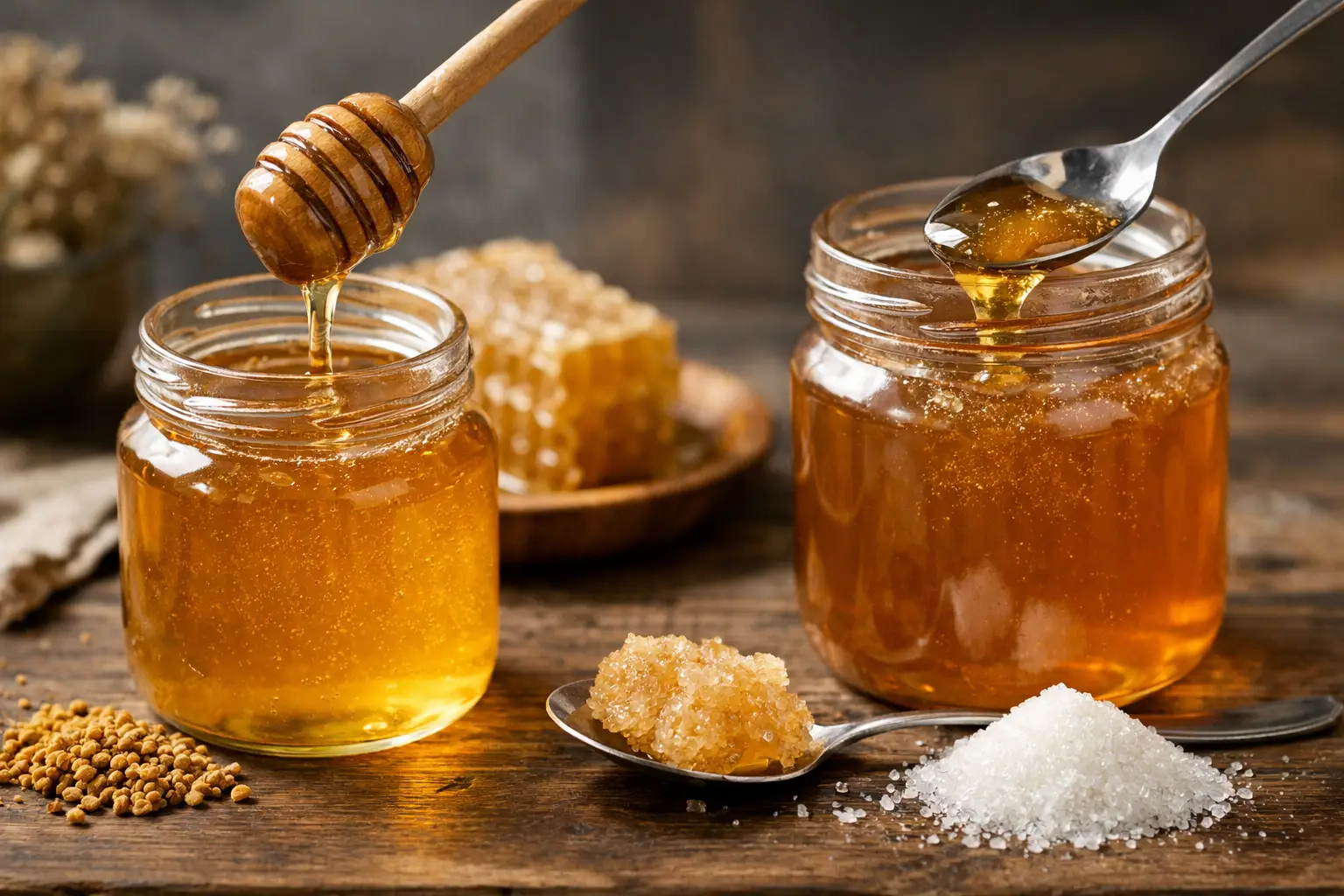
A honey jar can look beautiful on the shelf and still leave you with questions. The label may show a golden drizzle, a rustic hive, or words such as “pure” and “natural,” yet those claims alone do not tell you what is inside. Learning how to spot fake honey starts with looking beyond the color and the marketing to ask a more meaningful question: Can the seller clearly account for this honey’s origin, harvest, and journey to your table?
For families who choose honey for everyday nourishment, gifting, and traditional wellness, authenticity matters. Real honey is the work of bees, flowers, weather, and skilled beekeepers. It deserves more than a quick glance at a jar.
What “Fake Honey” Can Actually Mean
The phrase “fake honey” is often used for any honey that feels disappointing, but there are a few different concerns behind it. Some products may be blended with inexpensive sweeteners or syrups. Others may contain genuine honey but offer no meaningful information about where it came from or how it was handled. A jar can also be heavily filtered, overheated, or blended from many regions, which may change its flavor, aroma, and character without necessarily making it counterfeit.
That distinction matters. No one can reliably identify every issue by performing a kitchen experiment. Honey varies naturally according to floral source, climate, season, and storage conditions. The strongest sign of quality is not a viral trick involving water, fire, or a spoon. It is a transparent supply chain supported by a seller who is willing to stand behind the product.
How to Spot Fake Honey on the Label
Start with the ingredient statement. A straightforward jar of honey should list honey as the only ingredient. If you see glucose syrup, corn syrup, rice syrup, cane sugar, artificial flavoring, or a long list of additions, it is not pure honey in the traditional sense.
Then read the front and back labels together. Phrases like “honey blend,” “honey product,” or “made with honey” can signal that the jar is something other than single-ingredient honey. This is not always hidden, but the wording may be easy to miss when the front label emphasizes bees and flowers.
Origin should be equally clear. “Imported” is broad. “Packed in” describes where a product was bottled, not necessarily where bees gathered nectar. A more trustworthy product identifies a country, region, floral source, or producer relationship. For a prized varietal such as Yemeni Sidr honey, details matter even more. Sidr honey is valued because it is tied to nectar from Sidr trees and the distinct landscapes of Yemen. A vague label cannot carry the same assurance as a product with a traceable story.
Be cautious with sweeping wellness language, too. Honey has long been appreciated as a natural food, but claims that sound like a cure for every condition should prompt a closer look. Honest sellers focus on purity, taste, origin, and proper handling rather than impossible promises.
Look for information, not decorative language
Words such as “raw,” “organic,” “wild,” and “premium” may be meaningful when supported by specifics. On their own, they are not proof. Ask: Which flowers? Which region? Who harvested it? Is the seller clear about whether it is filtered or heat-treated? A premium price tag is also not proof of purity, though truly rare, origin-specific honey often costs more because careful sourcing and limited harvests cost more.
The Signs You Can Notice at Home
Your senses can help you appreciate honey, but they cannot replace verified testing. Genuine honey often has a layered aroma and flavor that reflects its source. One may taste lightly floral and bright, while another may be rich, earthy, herbal, buttery, or almost caramel-like. Authentic Sidr honey is often admired for its deep amber color, full body, and distinctive aromatic finish. Still, natural variation is part of the beauty. One harvest may not taste exactly like the next.
Texture can offer clues, but it is not a verdict. Honey may be thin when warm and thick when cool. Some varietals stay fluid for a long time, while others crystallize quickly. Crystallization is a natural process in many real honeys, especially when glucose content is higher or temperatures are cooler. It does not mean sugar has been added, and liquid honey is not automatically fake.
Color is similarly unreliable as a stand-alone test. Honey can range from nearly clear gold to dark mahogany. The nectar source, season, and storage all influence its shade. A very uniform color may be common in commercial blends, but it does not prove a jar is adulterated. Use what you see as one piece of a larger picture, not the final answer.
Skip the Internet Honey Tests
You may have seen claims that real honey will not dissolve in water, will burn when lit, will form a honeycomb pattern, or will not soak into bread. These tests are entertaining, but they are not dependable methods for detecting adulteration. Moisture level, temperature, container shape, and the honey’s natural sugar composition can all affect the result.
The same goes for the thumb test. Honey is naturally thick and sticky, but different varieties behave differently. A drop spreading on your thumb says far more about consistency than it does about purity.
When honey is seriously questioned, laboratories use specialized methods to examine its sugar profile, moisture, pollen, and other markers. Most shoppers do not need to become food scientists. They do need to buy from businesses that treat traceability as part of the product, not as an afterthought.
Choose a Seller That Can Tell the Full Story
A reliable specialty honey seller should make it easy to understand what you are buying. Look for clear ingredient information, a named origin, sensible storage guidance, and customer support that can answer direct questions. If the seller describes a single floral variety, they should be able to explain what makes it distinct.
For rare imported honey, direct sourcing is especially valuable. Honey can pass through many hands before it reaches a grocery shelf, and every unnecessary handoff makes origin harder to verify. Sellers with close relationships to harvesting communities can offer more confidence than anonymous, broadly labeled blends.
Yemen Honey Store is built around that principle: bringing authentic Yemeni Sidr honey, straight from the heart of Yemen, to customers seeking a pure and culturally significant food. The goal is not to make honey sound mysterious. It is to preserve the details that make a remarkable honey worth choosing in the first place.
Questions worth asking before you buy
Before selecting a jar, ask whether the honey has one ingredient, whether its country and region of origin are stated, and whether the seller explains its sourcing. Consider whether the price makes sense for the product’s rarity and harvest process. Finally, look at the seller’s overall consistency: clear descriptions, realistic claims, and a genuine respect for the people and place behind the honey are meaningful signs.
There is room for many kinds of honey at the table. A simple local wildflower honey can be wonderful, and a rare Sidr harvest can be a treasured addition to a wellness routine or a thoughtful gift. What matters is that the jar honestly represents what it is.
The next time you open honey, pause for its aroma, color, and flavor – then value the story that came with it. Nature’s Gold is most satisfying when you know exactly where it began.